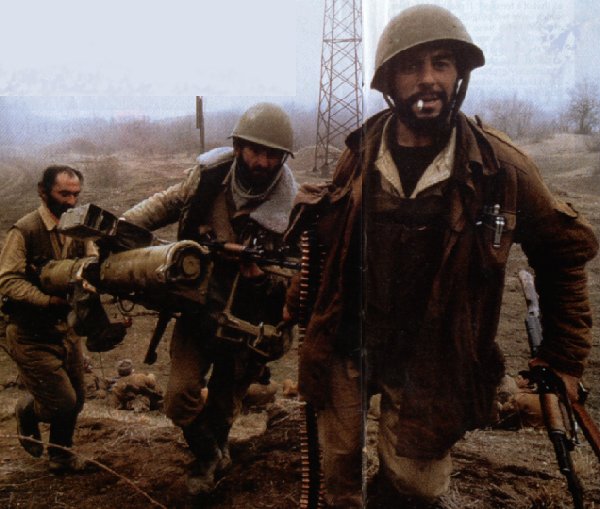
 In
Tzarist Russia, many Azeris graduated from Russian military academies,
and Azeri regiments of the imperial army were noted for their fighting
skill. In the Soviet military system, however, Azeris were underrepresented
in the top ranks of the armed forces, despite the presence of the Higher
All Arms Command School and the Caspian High Naval School in Azerbaijan.
Many Azeri conscripts were assigned to construction battalions, in which
military training was minimal and the troops carried out noncombat duties.
Pre-induction military training in most Azeri secondary schools was also
reportedly less stringent than in other Soviet republics. For these and
other reasons, the Azeris were not prepared for long-term warfare in Nagorno-Karabakh
when independence arrived.
In
Tzarist Russia, many Azeris graduated from Russian military academies,
and Azeri regiments of the imperial army were noted for their fighting
skill. In the Soviet military system, however, Azeris were underrepresented
in the top ranks of the armed forces, despite the presence of the Higher
All Arms Command School and the Caspian High Naval School in Azerbaijan.
Many Azeri conscripts were assigned to construction battalions, in which
military training was minimal and the troops carried out noncombat duties.
Pre-induction military training in most Azeri secondary schools was also
reportedly less stringent than in other Soviet republics. For these and
other reasons, the Azeris were not prepared for long-term warfare in Nagorno-Karabakh
when independence arrived.
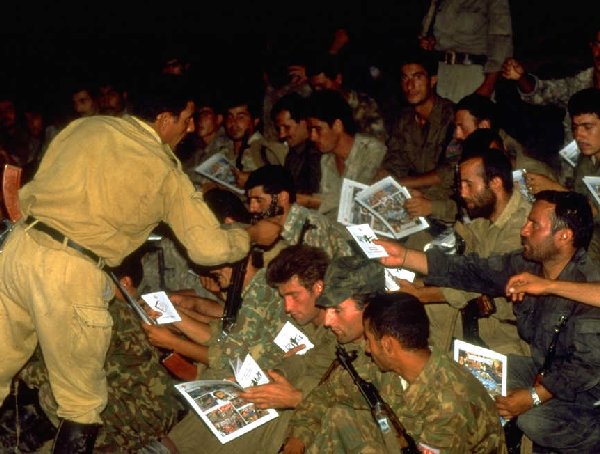 Even
before the formal breakup of the Soviet Union at the end of 1991, Azerbaijan
had created its own Ministry of Defense and a Defense Council to advise
the president on national security policy. The national armed forces of
Azerbaijan were formed by presidential decree in October 1991. Subsequently,
the Azerbaijani Supreme Soviet declared that the Soviet 4th Army, which
included most of the Soviet troops based in Azerbaijan, would be placed
under Azeri jurisdiction. About the same time, the Azeri Supreme Soviet
summoned Azeris serving in the Soviet armed forces outside Azerbaijan to
return and serve in their homeland. By the end of 1991, the Supreme Soviet
had enacted independently several statutes governing military matters.
Even
before the formal breakup of the Soviet Union at the end of 1991, Azerbaijan
had created its own Ministry of Defense and a Defense Council to advise
the president on national security policy. The national armed forces of
Azerbaijan were formed by presidential decree in October 1991. Subsequently,
the Azerbaijani Supreme Soviet declared that the Soviet 4th Army, which
included most of the Soviet troops based in Azerbaijan, would be placed
under Azeri jurisdiction. About the same time, the Azeri Supreme Soviet
summoned Azeris serving in the Soviet armed forces outside Azerbaijan to
return and serve in their homeland. By the end of 1991, the Supreme Soviet
had enacted independently several statutes governing military matters.
The president serves as the commander in chief of the Azeri armed forces. In this capacity, the president oversees defense and security efforts undertaken by the prime minister and the ministers of defense, internal affairs, and security. Between 1991 and 1993, Azeri presidents exercised this power by ousting several defense ministers because of alleged incompetence. Despite propitious legislation and decrees, however, efforts to field a national army faced many challenges.
According to an agreement between Russia and the Transcaucasian states calling for distribution of former Soviet military assets among the participating parties, Azerbaijan would receive most of the matériel of the 4th Army that had been stationed there, together with part of the Caspian Flotilla. Russians destroyed or removed much of their weaponry upon withdrawing, nevertheless some matériel was stolen, exchanged, or handed over to Azerbaijan. This way, the withdrawal of Russian troops and matériel left an Azeri army ill-equipped and poorly disciplined. During the initial phase of the Nagorno-Karabakh war most of the Azeri units were composed of irregular forces. After the ousting of President Mutalibov the Elchibey government established the basis for the organization of the armed forces, which were considerably strengthened by Aliyev.
Today, due to the unsolved conflict with Armenia, as well as the instability in neighbouring areas (Dagestan, Georgia, Chechnya) Azerbaijan still keeps large armed forces, consuming an important share of its budget. The Chinese and Russian not always discrete support of Armenia have led Azerbaijan to seek military co-operation with the west and the islamic countries. Turkish officers have served as advisers to the Azeri armed forces. Reportedly, a group of American mercenary advisers arrived in Azerbaijan in 1992, and some Americans were believed still in the country in early 1994. About 1,000 former Afghan freedom fighters were hired in 1993, and volunteers from other Muslim countries also reportedly enlisted. Foreign advisers still have an important role today. The main school for the for the army's officers is the "Higher Military Academy" in Baku.
Although the military were humiliated on the battlefield by the Armenians, they still exert great influence in Azerbaijan. Azerbaijan is a member of the NATO-led "Partnership for Peace" initiative and has resisted Russian attempts to bring it more closely into CIS security arrangements. Nevertheless Russia still operates a radar facility in Azerbaijan - tracking balistic missiles in the southern hemisphere. The country also integrates the "Georgia, Ukrain, Azerbaijan, Moldova regional co-operation group", known as GUAM.
Military
branches:
- Army,
- Navy,
- Air and Air Defence
Forces,
- Border Guards.
 The
army
has a force around of 100,000. Most equipment is of Russian origin. It's
armoured units are equiped with T-72 and T-55 tanks. Its main APCs are
the MT-LB and the BMP-1. Its mobile artillery units use the 2S1 Gvozdika
122-mm self-propelled howitzer and the BM-21 Grad 122 mm multiple-launch
rocket system developed in the early 1960s.
The
army
has a force around of 100,000. Most equipment is of Russian origin. It's
armoured units are equiped with T-72 and T-55 tanks. Its main APCs are
the MT-LB and the BMP-1. Its mobile artillery units use the 2S1 Gvozdika
122-mm self-propelled howitzer and the BM-21 Grad 122 mm multiple-launch
rocket system developed in the early 1960s.
 Formed
in mid-1992, the Azeri navy inherited the former Soviet Caspian
Flotilla and Border Guard vessels. The navy has about 5,000 personnel.
The navy operates 7 patrol boats (2 - OSA-II-Class and 5 - Stenka-Class),
7 minesweepers (2 - Sonya-Class and 5 - Yevgenya-Class), 6 landing crafts,
2 landing cutters, 1 special purposes vessel and 1 special purposes cutter.
Some units operate under CIS command.
Formed
in mid-1992, the Azeri navy inherited the former Soviet Caspian
Flotilla and Border Guard vessels. The navy has about 5,000 personnel.
The navy operates 7 patrol boats (2 - OSA-II-Class and 5 - Stenka-Class),
7 minesweepers (2 - Sonya-Class and 5 - Yevgenya-Class), 6 landing crafts,
2 landing cutters, 1 special purposes vessel and 1 special purposes cutter.
Some units operate under CIS command.
 The
air
force has about 7,000 troops. It currently has about 170 planes and
60 helicopters on 16 bases. Its backbone is a squad of MiG-25 Foxbat fighters,
but it also operates Su-25 Frogfoot Ground attack planes, Su-24 Fencer
fighter bombers and Tu-16 Badger heavy bombers. There is an helicopter
squadron operating Mi-24 attack gunships, Mi-8 Assault/transport helicopters
and Mi-2 Transport helicopters.
The
air
force has about 7,000 troops. It currently has about 170 planes and
60 helicopters on 16 bases. Its backbone is a squad of MiG-25 Foxbat fighters,
but it also operates Su-25 Frogfoot Ground attack planes, Su-24 Fencer
fighter bombers and Tu-16 Badger heavy bombers. There is an helicopter
squadron operating Mi-24 attack gunships, Mi-8 Assault/transport helicopters
and Mi-2 Transport helicopters.
Azerbaijani Azerbaijani
Air
Defense has about 3,500 personnel. Azerbaijan has also a missile
system covering the Azeri Aerospace. The NATO designated SA-2 Guideline
(original name S-75) has been installed in and around Baku and additional
installations exist along the border with Iran and the Dagestan republic.
Radars are mostly from the Cold War period, with some recent additions
procured from the US. The US are installing two radar stations on the Russia-Azerbaijani
border and Iran-Azerbaijani border to monitor Caspian Sea traffic, reinforcing
Azerbaijan's position as an American vassal state in the area and positioning
it against both Russia and Iran.
Military
manpower:
The armed forces
rely mostly on conscripts. Chiefly young men from poor backgrounds are
drafted, it is widely reported that a 2,000 Euro bribe can assure an exemption
from military service on spurious ill-health grounds. Poor and cramped
conditions in army barracks exacerbate and spread diseases such as tuberculosis,
diphtheria, and typhoid. An alleged culture of corruption, bullying, and
neglect in the army continues to cause deaths unrelated to combat. Many
soldiers are victims of organized extortion from their officers.
- conscription:
the law requires at least 17 months of service from adult males
- military age:
18 years of age
- availability:
males age 15-49: 2,131,331 (2002 est.)
- fit for military
service: males age 15-49: 1,706,325 (2002 est.)
- reaching military
age annually: males: 77,099 (2002 est.)
Military expenditures: $2.5 Billion - 3.3% of GDP, and five times higher that those of Armenia (2009 est.). The slice of the budget allocated to the military has risen sharply, due to the increasing oil revenue. In spite of this spending, the armed forces face serious economical problems, partly due to corruption, leaving both soldiers and officers in dire straits. The president even established a charitable fund to help. In October 2008, the International Crisis Group described Azerbaijan's armed forces as "fragmented, divided, accountable-to-no-one-but-the-president, un-transparent, corrupt and internally feuding".
Defense Industry:
The defense industry of Azerbaijan was
established in 2005 by presidential decree, the new Defense Industries
Ministry, incorporated the State Departments for Military Industry and
for Armaments and the Military Science Center, each of which was formerly
a separate agency within the Azerbaijani Defense Ministry. The defense
industry was funded with $600 million for 2007. Azerbaijan manufactures
armoured personnel carriers and infantry fighting vehicles, as well as
small calibre artillery guns. The new ministry is cooperating with the
defense sectors of Turkey and Pakistan. Azerbaijan defense exports are
less than transparent.
sources: CIA, Library of Congress, Jane's, BBC, HRW, Wikipedia