 Situated
700m above sea level, like an amphitheatre surrounded by mountains and
forests of oak trees, Sheki rises above fertile yaylags (pastures) and
fields. The area is very picturesque, with narrow gorges and green valleys,
springs, water falls and mineral water springs framed by dense woods and
alpine meadows.
Situated
700m above sea level, like an amphitheatre surrounded by mountains and
forests of oak trees, Sheki rises above fertile yaylags (pastures) and
fields. The area is very picturesque, with narrow gorges and green valleys,
springs, water falls and mineral water springs framed by dense woods and
alpine meadows.
In the town, you'll see old brick houses, shaded streets, weeping willow trees and canals carrying spring water.
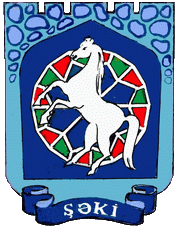 The
original settlement dates back to the late bronze age. Once we enter recorded
history,
invaders were frequent visitors. Its name is believed to originate from
the name of saks tribe that arrived in Azerbaijan in VII B.C. The city
became very well known as a center of Sakasena region of Alban kingdom.
When Christianity spread in the Caucasus, Sheki became one of its important
centers. During the 7th century Sheki was taken by arab invaders becoming
dependent on a local emirate - Sheki suffered from Arab-Khazar war for
150 years. However in the 9th century with the weakening of arab power
a Christian state was re-established by the last remaining forces of the
Albanian kings. It was later taken by the Shirvanshahs, the Mongols under
Tamerlane and the Safavids. By the 18th century Sheki was capital of its
own Khanate, only to be taken by the Russian Empire in 1805. Following
the Russian revolution the Red Army eventually only took Sheki in 1920.
The
original settlement dates back to the late bronze age. Once we enter recorded
history,
invaders were frequent visitors. Its name is believed to originate from
the name of saks tribe that arrived in Azerbaijan in VII B.C. The city
became very well known as a center of Sakasena region of Alban kingdom.
When Christianity spread in the Caucasus, Sheki became one of its important
centers. During the 7th century Sheki was taken by arab invaders becoming
dependent on a local emirate - Sheki suffered from Arab-Khazar war for
150 years. However in the 9th century with the weakening of arab power
a Christian state was re-established by the last remaining forces of the
Albanian kings. It was later taken by the Shirvanshahs, the Mongols under
Tamerlane and the Safavids. By the 18th century Sheki was capital of its
own Khanate, only to be taken by the Russian Empire in 1805. Following
the Russian revolution the Red Army eventually only took Sheki in 1920.
 Located
on the left bank of the river Kish, originally the town sited lower down
the hill, however Sheki was moved to its present location after a devastating
mud flood in 1772. As the new location was near the village of Nukha the
city became also known as Nukha, until 1960 when it reverted back to the
name Sheki, after the Saki tribe.
Located
on the left bank of the river Kish, originally the town sited lower down
the hill, however Sheki was moved to its present location after a devastating
mud flood in 1772. As the new location was near the village of Nukha the
city became also known as Nukha, until 1960 when it reverted back to the
name Sheki, after the Saki tribe.
Sheki is long famed as a silk centre and an important stop on the silk route, Sheki is still the site of a huge factory that was once the Soviet Union's largest silk plant (such a big factory was naturally named after Lenin... - now ask for the 'ipek kombinat'). In its golden period the factory employed over 7.000 (out of a population reaching almost 100.000). Nowadays the silk industry is still alive, but through smaller private workshops. The agricultural activity is quite important, with tobacco, grapes, grain, nuts, cattle and milk as the the main products.
 Sheki
is famous for the 18th century Khan's summer palace. It was built
in 1762 by Hussein khan who was also well known as a poet under his pen-name
Mushtag. The two-storied building is decorated with magnificent frescos
(one 24 m long) and exquisite stained glass work, known as 'shebeke'
(northern part of the city). The Turkish poet Nazim Hikmet wrote: "If there
will be no other building in Azerbaijan it will be enough to show Khan
Palace to the world".
Sheki
is famous for the 18th century Khan's summer palace. It was built
in 1762 by Hussein khan who was also well known as a poet under his pen-name
Mushtag. The two-storied building is decorated with magnificent frescos
(one 24 m long) and exquisite stained glass work, known as 'shebeke'
(northern part of the city). The Turkish poet Nazim Hikmet wrote: "If there
will be no other building in Azerbaijan it will be enough to show Khan
Palace to the world".
 Measuring
thirty-two meters by eight and a half meters on the exterior, the palace
is a two-story brick masonry structure elongated on the north-south axis
and covered with a wooden hipped roof with long eaves. The layout of both
floors is identical; three rectangular rooms are placed in a row, separated
by narrow, south-facing iwans that provide access to the rooms.
Measuring
thirty-two meters by eight and a half meters on the exterior, the palace
is a two-story brick masonry structure elongated on the north-south axis
and covered with a wooden hipped roof with long eaves. The layout of both
floors is identical; three rectangular rooms are placed in a row, separated
by narrow, south-facing iwans that provide access to the rooms.
 The
summer residence is renowned for the lavish decoration of its exterior
and interior. The façades are covered in tiles with floral and geometrical
motives. The interior walls of the residence are covered with frescoes
painted during the eighteenth century. Many of the frescoes feature flowers
in vases, while a series of paintings on the first floor halls depict hunting
and battle scenes. Signatures on frescoes list the names of artists Ali
Kuli, Kurban Kuli and Mizra Jafar from Shemaha, Usta Gambar from Shusha,
and Abbas Kuli, who may also have been the architect of the summer residence.
The
summer residence is renowned for the lavish decoration of its exterior
and interior. The façades are covered in tiles with floral and geometrical
motives. The interior walls of the residence are covered with frescoes
painted during the eighteenth century. Many of the frescoes feature flowers
in vases, while a series of paintings on the first floor halls depict hunting
and battle scenes. Signatures on frescoes list the names of artists Ali
Kuli, Kurban Kuli and Mizra Jafar from Shemaha, Usta Gambar from Shusha,
and Abbas Kuli, who may also have been the architect of the summer residence.
 Besides
the palace have a look at the fortress that envolves it. The overall
length of the walls is about 1,300 km. It has two gates and defensive towers
on the southern and northern sides, the castle looks much better than most
in Azerbaijan, as it underwent extensive restoration work in the early
1960s.
Besides
the palace have a look at the fortress that envolves it. The overall
length of the walls is about 1,300 km. It has two gates and defensive towers
on the southern and northern sides, the castle looks much better than most
in Azerbaijan, as it underwent extensive restoration work in the early
1960s.
Inside the walls of the castle are also located two museums. The largest is Sheki's History Museum, with artifacts from several periods, but notorious for pieces relating to silk manufacturing and trade. The other is a 19th century 'Albanian' church that now houses the crafts museum.
 Visit
also the baths and the three mosques - Juma, Omar Efendi and Gileili
mosques (the latter only a minaret). The Djuma Mosque (aka Khan's mosque)
was constructed in 1745-1750, near the market square and boasts at 40 m
tall minaret. Directly in front of the mosque is a small cemetery. Gadzhi
Chelebi, a ruler of Sheky in the 18th century and some of his courtiers
were buried there. These tombs are topped by domes and gravestones with
cut out lettering in Arabic. Sheki has a very well preserved bath
of the19th century, with to large halls - one for undressing, and the other
- for bathing, with a warmed up floor.
Visit
also the baths and the three mosques - Juma, Omar Efendi and Gileili
mosques (the latter only a minaret). The Djuma Mosque (aka Khan's mosque)
was constructed in 1745-1750, near the market square and boasts at 40 m
tall minaret. Directly in front of the mosque is a small cemetery. Gadzhi
Chelebi, a ruler of Sheky in the 18th century and some of his courtiers
were buried there. These tombs are topped by domes and gravestones with
cut out lettering in Arabic. Sheki has a very well preserved bath
of the19th century, with to large halls - one for undressing, and the other
- for bathing, with a warmed up floor.
 Not
to be missed is the reconstructed upper caravansaray located on
the right bank of the river Gurjanachai - this is the main hotel
used by organized tours, so the chances are that you'll stay there (good
food at the hotel's restaurant). The lower caravansaray is located nearby,
but it is now used as a warehouse. For a bit of luxury we suggest the five
star Sheki Saray Hotel on M.E.Rasulzade Street, probably
one of the best hotels outside Baku (not to be confused with the more modest
Sheki Hotel, above the Capital Bank).
Not
to be missed is the reconstructed upper caravansaray located on
the right bank of the river Gurjanachai - this is the main hotel
used by organized tours, so the chances are that you'll stay there (good
food at the hotel's restaurant). The lower caravansaray is located nearby,
but it is now used as a warehouse. For a bit of luxury we suggest the five
star Sheki Saray Hotel on M.E.Rasulzade Street, probably
one of the best hotels outside Baku (not to be confused with the more modest
Sheki Hotel, above the Capital Bank).
Although the centre is dominated by two Soviet towers, you will see everywhere an horizon of red tiled roofs. For entertainment try the state Drama theatre, on Azadlyg street or try the Chingis Club. In Azerbaijan you should not miss a typical house-museum, in this case have a look at the Rashidbey Efendihad House Museum, on the road to the Khansarai - dedicated to one of Sheki's most famous educators and authors. If truly desperate to kill time or suffering a sudden attack of DPRK nostalgia then try the Heydar Aliyev Museum.
 If
you have an appetite, try one of the
confectionery shops, that are
famous throughout the country for the sweet 'halva', a a special
type of baklava prepared from nuts, walnuts, butter, sugar and spices.
The market is held on the street along the river-bed of the Gurjanachai
river.
If
you have an appetite, try one of the
confectionery shops, that are
famous throughout the country for the sweet 'halva', a a special
type of baklava prepared from nuts, walnuts, butter, sugar and spices.
The market is held on the street along the river-bed of the Gurjanachai
river.
If you still have the time have a look at the Gelersen-Gerersen castle ruins and the 7th century Albanian churches in the villages of Orta Zeizit and Kish, just north of Sheki.
 Sheki
is served by trains and you can get buses to most major cities in Azerbaijan
as well as to Tbilisi. The train station has a somewhat inconvenient
location about 10km from the city center. In order to reach the station
you will either have to take a taxi or hop on a Baku-bound bus or minibus
and ask the driver to drop you off by the railroad station, and then walk
about 5 minutes to the station. There are night trains that run from Baku-Balakan
and make a stop in Sheki. There is also a Balakan-Baku train that passes
through Sheki. Passengers must produce their passports in order to buy
tickets.
Sheki
is served by trains and you can get buses to most major cities in Azerbaijan
as well as to Tbilisi. The train station has a somewhat inconvenient
location about 10km from the city center. In order to reach the station
you will either have to take a taxi or hop on a Baku-bound bus or minibus
and ask the driver to drop you off by the railroad station, and then walk
about 5 minutes to the station. There are night trains that run from Baku-Balakan
and make a stop in Sheki. There is also a Balakan-Baku train that passes
through Sheki. Passengers must produce their passports in order to buy
tickets.
 The
bus
station (avtovagzal) is in the southern end of the town. This is one of
the more tedious ways to get to Sheki, taking nearly 7 hours, because the
mountain pass used by cars and marshrutki would be out of the question
for a large bus. Although slower, buses are more comfortable than minibuses
(marshrutki), although the ones with air conditioning overdo the cold air
in a big way. Marshrutki run between many of the major cities to the Sheki
bus station, and take 6 hours to/from Baku. Use your discretion when riding
the minibuses as the condition of both vehicles and drivers vary - this
matters, given the exceptionally steep road, full of sharp curves, that
awaits.
The
bus
station (avtovagzal) is in the southern end of the town. This is one of
the more tedious ways to get to Sheki, taking nearly 7 hours, because the
mountain pass used by cars and marshrutki would be out of the question
for a large bus. Although slower, buses are more comfortable than minibuses
(marshrutki), although the ones with air conditioning overdo the cold air
in a big way. Marshrutki run between many of the major cities to the Sheki
bus station, and take 6 hours to/from Baku. Use your discretion when riding
the minibuses as the condition of both vehicles and drivers vary - this
matters, given the exceptionally steep road, full of sharp curves, that
awaits.
Emergency Contact Numbers

- Fire: 0177-101
- Police: 0177-102
- Ambulance: 0177-103
- City hospital: 0177-42-466
The city hospital is near the center of
Sheki, right across the street from the Drama Theater.
(380 km northwest of Baku)